Using AI-assisted prototyping to test ideas faster
I turned a dormant product idea and a set of static advisor-portal designs into working, testable prototypes in days instead of weeks. Then I used them to sharpen usability research and show the organisation what faster, AI-assisted prototyping could do for product quality.
Goal
Find out whether the mortgage-acceleration idea actually held up, and get a sharper usability read on the new advisor-portal flow than static designs could give.
Outcome
Two working prototypes, sharper usability findings on both, and follow-up conversations with management teams about using the same approach elsewhere.
My role
Prototyping, research, internal advocacy.
Team
Built the prototypes independently, with occasional feedback from colleagues along the way; testing was set up and carried out together with them.
Context
NN had two open questions. Did a mortgage-acceleration idea that had been floating around for ages actually hold up once real people looked at it? And did a new flow in the advisor portal work, beyond what a round of testing on static screens could tell us?
Both needed a real answer, not a guess extended from a deck or a set of Figma frames.
Getting to a real answer
To test either one properly, people needed something to actually use, not describe. So I built both as working prototypes in VS Code with Claude Code, fast enough that testing didn’t have to wait on a normal build cycle. The speed wasn’t the goal. It’s just what made testing the real thing possible in days instead of weeks.
The Hypotheekversneller: reviving a dormant idea
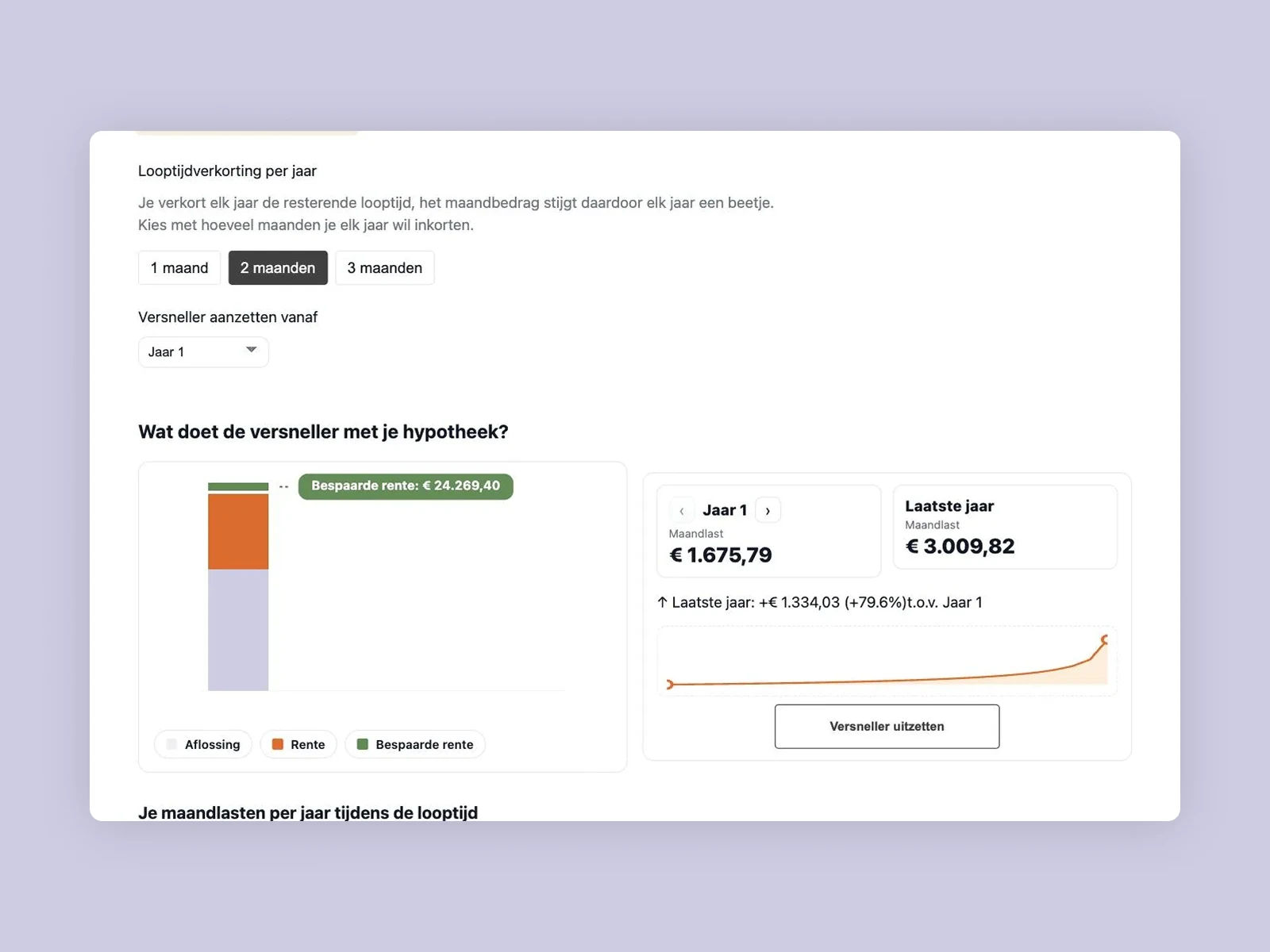
The extra-repayment idea had been around for a while. People had a hunch it might work, but nobody had enough to actually move forward on it. So instead of arguing about it, I prototyped it: a working calculator someone could actually put their own numbers into and see what accelerating their mortgage would do to their interest costs.
I tested it internally first, then with mortgage advisors and customers. The research concluded the idea had real potential: not a hunch anymore, an answer.
The Hypotheekversneller prototype — built to test a dormant idea, fast.
The advisor flow: from static screens to a second usability round
The mortgage-mutation flow in the advisor portal had already been designed and tested once, but only as static screens, which only tells you so much. I rebuilt the entire flow as a working prototype in three days and ran a second usability round on it.
That round caught things the first one couldn’t have: a few steps got reshuffled, and some smaller usability issues surfaced that only show up once something actually behaves like software.
The advisor-portal flow, rebuilt as a full interactive prototype.
Beyond the research
Both prototypes ended up doing more than answering their own question. I used them in conversations with management teams to explain what AI-assisted prototyping makes possible, and to prove it: something they could click through themselves, not just hear about. Those conversations kept going after the fact, about where else this approach could apply.
Closing thoughts
Neither prototype was the point, really. What mattered was how fast the gap between an idea and a testable answer had gotten: fast enough to settle a years-old question in days, and fast enough that showing people the tool was more convincing than describing it.